
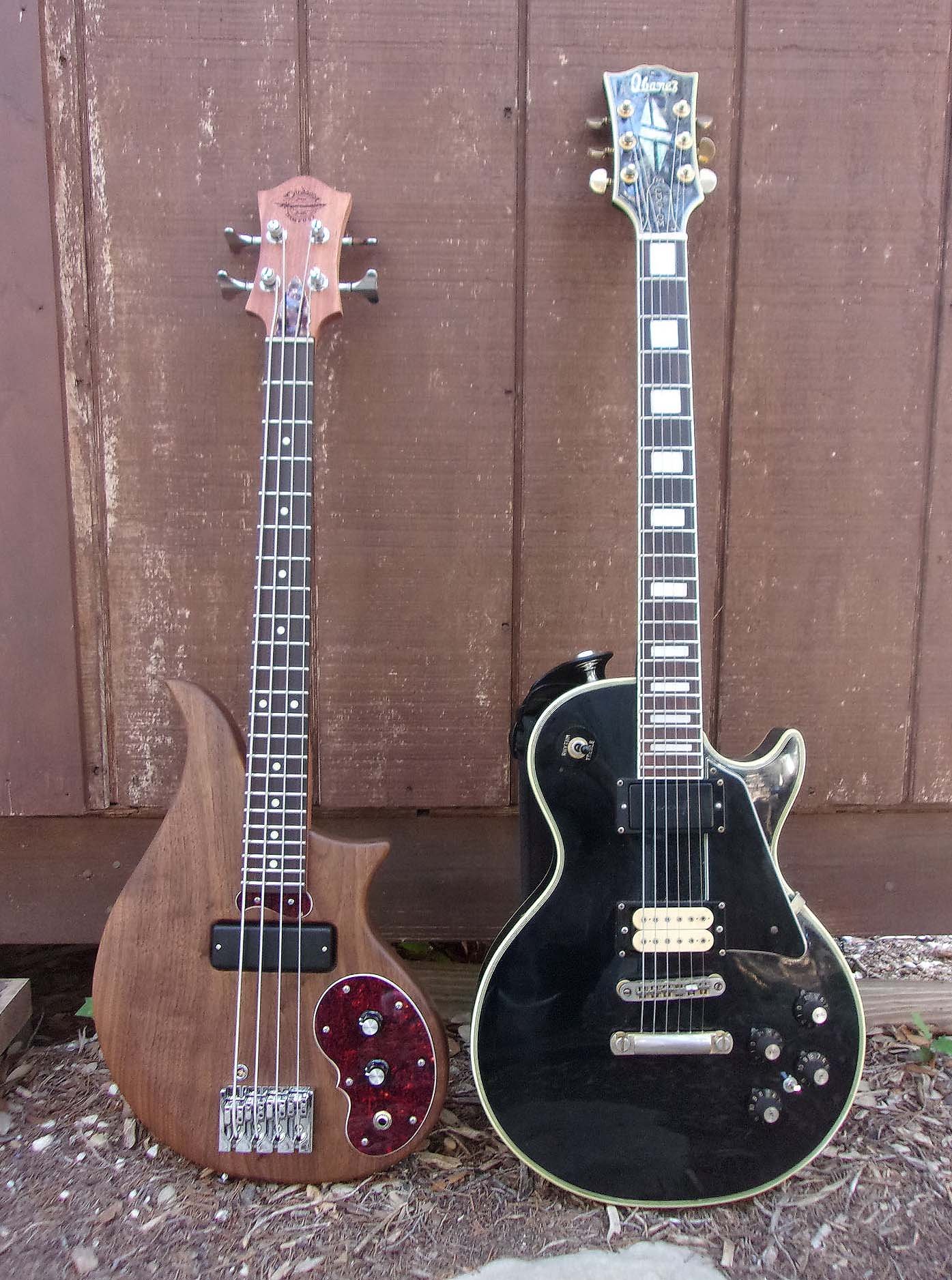
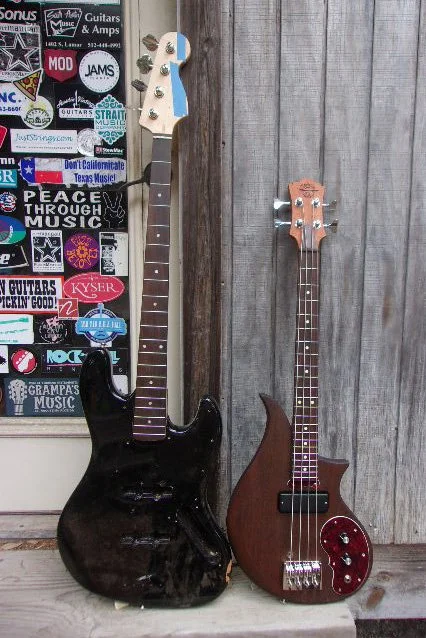
“What’s a pocket bass?”
A little bass that fits!
You don’t wear somebody else’s shoes, you’re not forced to drive a ‘72 Buick, and you probably have chairs in your house that comfortably fit your body. That’s why you bought them, and the vehicle that suits your needs, and the shoes that fit YOUR feet.
In the bass guitar world, one size became “The standard” and for a long time anything shorter was seen as a joke or was made cheaply for kids. Partially because that was true! We’ll get to that. Quickly, a quick bit on SCALE.
THE SCALE LENGTH of a stringed instrument is the vibrating length of the string between the nut (where it’s held spaced in string slots) to the bridge (where the string comes up and across string saddles). By default this contributes the size of the instrument.
The industry standard “long scale” regular mostly seen basses are 34” scale.
Medium scale basses are 32-34" scale.
Short scale basses are usually 30-32” scale.
Then we get to pocket basses. I started using the term “Short basses” because you know right away what’s up with them. These were basses made using guitar parts, so they would up somewhere around 25” scale length.
The problem is that when you shorten the scale, you shorten the bass - otherwise why even do it? But when you shorten it all, you lose some tension… with that resonance, sustain, depth and clarity. It’s the tension that helps the string vibrate, like those long strings inside a piano. On an electric instrument, that vibrating gives back characteristics of the structure and wood into the string vibration, which is picked up by the pickup and amplified into sound by the amplifier.
What I’ve devoted my career in this to is compensation and working around what happens when you take some of that tension away to get a smaller, shorter, better balanced, more comfortable playing bass. Birdsong basses are a proprietary 31” scale, and I wanted to see how far I could push it - so I did. And the 25.5” scale mini basses, these “guitar scale” pocket basses, they sound like a really good conventional short scale - all the warm mids and round bottom of a short scale, but WITH sustain and clarity and deep lows too!
Most short scales in the 1990s were re-issues of old, thuddy, imbalanced designs from the 60s that looked cool but sucked, or cheapie shrunken Fender styles to sell to kids… which sucked. There were boutique shorties that cost as much as a car, but you’re not showing up at the blues jam or playing bars with them, or tossing those in the trailer for a tour. There were no “general business” short scales that were anywhere near as good as the full scale basses. Nifty, quirky, fun? Sure. But that’s it.
Birdsong helped legitimize short scales as potential pro-quality instruments, more than vintage novelties. Real crafted handwork, professional bassist design, repairman engineered, full sounding ergonomic beauties. And many years later with a younger, stronger luthier continuing the Birdsong building in Texas, I’m up on a rural Adirondack farmstead with the super-short scale line I developed as part of Birdsong. I continue to do the same for pocket basses with (now) these signature shortbasses.