The Shortbass story
The first time I played a short scale bass it was a revelation - like feeling shoes that really finally fit right. But the balance sucked, and I wanted that big bass tone. So I started modifying things. Eventually I had a repair client who’d seen my first few guitars and wanted a small bass that’d be easy for him to play. It was 1998, I built one; then a few more. Trying ideas and pickups and seeing how things changed. My brand was my name signed on the headstock.
By 2000 I was in Texas again and continued, coming up with Birdsong, and the Cortobass, and with great folks building a company off of it. I had settled into a basic set of specs that really worked, and off we went! Along the way, a client asked for an even shorter bass. I needed to see if all I’d done to make a short scale behave like a full scale could make an even shorter bass sound like a good short scale…
So I grabbed an in-process Birdsong GUITAR (a model at the time) and finished it as a 25.5” scale “pocket bass,” tossing our DST double string through we use on the low Bs of our 5s onto the E string on it. Not only did it work well enough that I built the client his 28s, it became its own 25.5 model, the Sparrow. That was the beginning of Birdsong’s super short scales, made along-side the proprietary 31” scales we’re known for.
I kept tweaking the design through a few more models, and after handing the day-to-day Birdsong crafting off to our Head Luthier, these super shorties came with me to build in far north rural NY. I do a mix of orders and inventory builds in small batches, and like short scales weren’t taken seriously or all that great in eras past, I hope to change that now for “pocket basses” with my Shortbasses.
They’re fun, they travel really well, and ergonomically they’re great for shorter arms or anyone looking for a small bass, especially as we age or deal with injuries or motion issues. These have been the difference in some bassists remaining playing vs. not, and that touches me deeply to be able to help that with my work. Honestly, I’m honored to be a part of music being made.
The Shortbass name was used on a model I built (and signed the headstocks, they’re not Birdsongs) on the side for a number of years, but that’s what I call these little basses now. (In fact, the Amigo has the body of the old “Scott’s Shortbass.”) Anything I make is gig-worthy. These basses are small, like a light touch, and reward the player with no reach, soft feel, and the kind of real bass voice never available in one so short. With no trick electronics and no weirdo hard to find strings!
These are my passion and I’ll keep building as long as I can.

Design philosophy
My basic design philosophy for whatever instrument - guitar, bass, lap steel - is that “The truth is what comes out of the speaker.” If that has changed, it has changed REGARDLESS of who said it wouldn’t or why it can’t or anything else. And if it’s good, it’s GOOD regardless of what it took to get it there, how far I had to veer from tradition, or what parts did what to add up sonically to that goodness.
Also with that philosophy is the basis of how I voice these things. I don’t look on paper for this number or that value or whatever… I listen to the sound and, if something’s missing that I want to be IN there, I know there are a few ingredients or materials or techniques that tend to bring that particular frequency range or response out of a bass or guitar, and that’s what I add to the recipe.
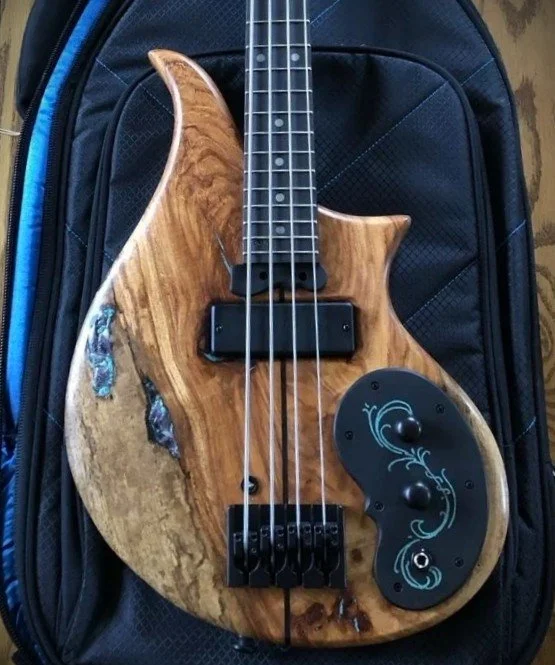
As far as form goes, I make shapes I like, influenced by nature and seed and classic car fenders and (fancier stuff) ends of old furniture pieces, grandfather clocks, old silverware, Art Deco, nouveau, southwestern and native art, and rustic design. I combine all of this and craft to a very high level, but NOT to where every mark of handwork or feel of natural wood is gone. Those are important.
An instrument is your creative voice, the tool that sets your good vibrations out into the air, off into the world. It should look like what inspires you, who you are inside, your vibe. And it should hold itself in position and do as you ask of it - wood first, as reported by the pickup, then seasoned by the amp and effects.
Which a well designed instrument will do - it’s when we start combining things off of lists and with no concept of dovetailing what they bring, that things clash and begin subtracting resonance and sustain and frequency ranges. Ingredients with the “right” name and pedigree, but working against each other in that recipe. I watch out for that every step of the way, bring ingredients that work together and bring out the best in each other, and the magic beyond the sum of it all takes care of itself.
It’s been an unusual life
But I knew music was going to be my path the minute it came into my life. (More coming…)